

The Sacrum: The Keystone of Your Body
Jason Alston
Your body is great at hiding where the real problem is. And more often than not, it leads back to your pelvis, even if that’s not where you feel the pain.
Let’s break this down:
Pelvis vs. Hip
First, understand that your pelvis isn’t the same thing as your hip.
- The pelvis is the actual bony structure made up of the sacrum and the two ilium bones, what you feel when you put your hands on your waist.
- The hip is a joint, specifically the ball and socket joint where the top of your thigh bone, the femur, fits into the socket of your pelvis.
So when I talk about pelvic mobility, I’m not just talking about your hip joint. I’m talking about how the entire pelvic structure moves, especially at the SI joints, where your sacrum, the upside down triangle at the bottom of the spine, connects to each side of your pelvis.
What I See In Practice
In my practice as a Myopractor, I’ve seen this scenario over and over again.
Someone comes in with shoulder pain, neck tension, or even foot discomfort.
And often the real issue is a restriction in one or both of their SI joints.
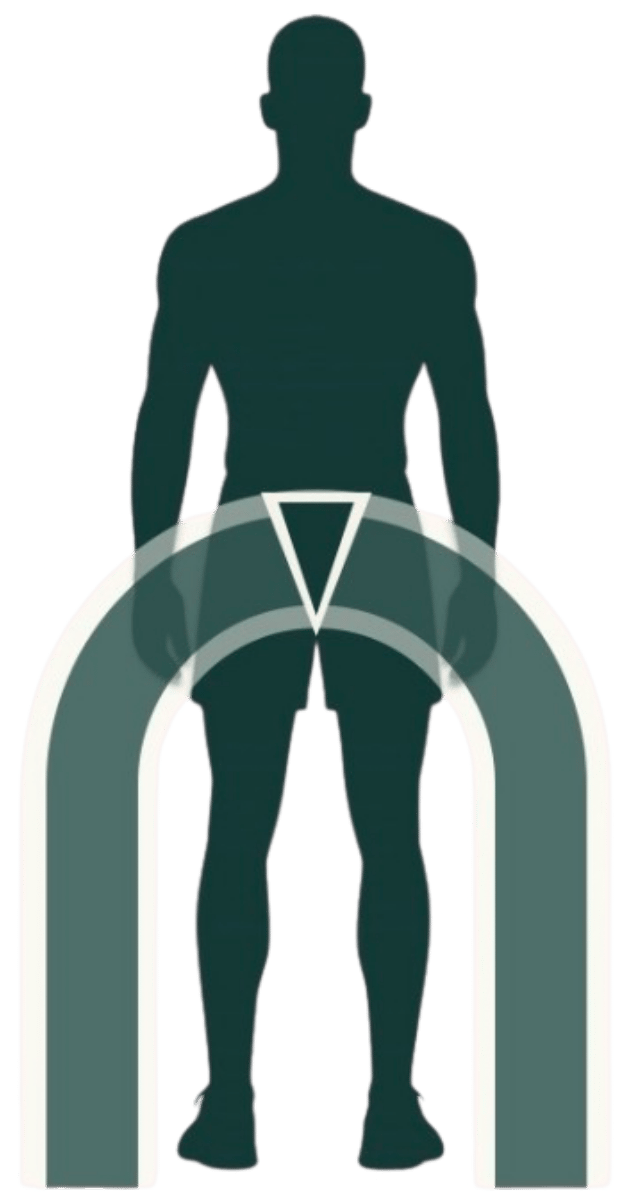
The Sacrum: The Keystone of Your Body
Think of your lower body like an ancient arch. In architecture, an arch is only stable because of the keystone, the wedge shaped stone at the very top that locks everything into place.
In your body, the sacrum is that keystone. The SI joints on either side are where the arch extends down into your legs. If the sacrum isn’t moving properly, the whole structure above and below it is affected.
The body is amazing in its ability to adapt and compensate to keep you upright. But that compensation comes at a cost.
When the Foundation Is Off, Everything Else Follows
Let’s say your right SI joint is restricted. Here’s one common pattern I see:
- The muscles around your left lumbar spine tighten to compensate.
- That tension shifts up to the right side of your thoracic spine.
- Then it crosses back over to the left side of your neck and shoulder.
- And sometimes, it zigzags again, back to the right side of your head or jaw.
This isn’t just theory. This is what I see in real bodies, every week.
Even if you don’t have scoliosis, your spine can start to behave like the Leaning Tower of Pisa. Your body adapts and compensates to keep you upright.
And when that happens, you might feel it in:
- Your hips
- Your knees
- Your shoulders
- Your jaw
- Even your feet
Biotensegrity: Why It All Connects
There’s a concept called biotensegrity that helps explain this. It’s the idea that your body is a tension based structure, like a suspension bridge or a tensegrity model. When one area is under tension, it pulls on everything else.
So What Can You Do?
Here are a few simple ways to start improving pelvic mobility and stability on your own:
1. Pelvic Tilts
- Lie on your back with knees bent.
- Gently draw your belly button in toward the floor. Hold for a few seconds.
- Then raise it toward the ceiling.
- Repeat 10 to 20 times.
This helps reintroduce motion into the sacrum and lumbar spine.
2. Kegels
Yes, these benefit men too.
Locating the right muscles:
- Imagine you’re trying to stop the flow of urine midstream or hold in gas.
- The muscles you engage to do that are your pelvic floor muscles.
How to do it:
- Gently squeeze and lift those muscles.
- Avoid tightening your stomach, thighs, or glutes. Focus on the pelvic floor.
- Hold for about 3 to 5 seconds, then fully relax for the same amount of time.
- Aim for 10 reps per set, and try to do 2 to 3 sets throughout the day.
Strengthening your pelvic floor helps stabilize the sacrum and support better movement.
3. Bridges
- Lie on your back with knees bent and feet flat on the floor, hip width apart.
- Press through your heels to lift your hips off the ground. Raise no higher than the point where your body forms a straight line from shoulders to knees.
- Hold for a second at the top, then lower down with control.
- Aim for 10 to 15 reps per set and work your way up to 2 to 3 sets.
Strengthens the glutes, hamstrings, and core. Promotes pelvic stability. Improves hip mobility. Supports better posture and lower back health.
Why I Start With the Pelvis
As a Myopractor, I specialize in full body mobilization, but I always start with the pelvis. If the foundation isn’t moving well, nothing else will hold.
The full body approach starting with the pelvis is why myopractic sessions tend to get better, longer lasting results. We’re not just chasing symptoms. We’re restoring proper mobility to the structure.
So whether you’re dealing with shoulder tension, low back discomfort, or you just want to move better, start with your sacrum. It’s the keystone of your body. When it moves well, everything else has a chance to move better too.

Join the Life Is Motion Newsletter for practical ideas to help you better understand your body, move better, build healthier habits, and become the healthiest version of yourself.

What Is Myopractic?
Myopractic is a whole-body approach to helping restore healthy movement. Rather than focusing only on where you feel the problem, we look at how your body is moving as a whole.

Body alignment is about more than posture or how your body looks. Learn how mobility, strength, stability, and everyday movement work together—and what you can do to help your body move and function better.

Myopractic and chiropractic both use hands-on techniques, but their philosophies and approaches are very different. Learn how they compare in focus, approach, scope, and frequency.

Drinking enough water is important, but there's more to staying hydrated. Learn how water, electrolytes, daily habits, and a few simple tools can help you stay hydrated and keep your body moving.
Ready to Schedule?
Each Myopractic session begins by getting the hips balanced and moving, followed by a whole-body evaluation and treatment. Rather than just focusing only on where you're experiencing discomfort, Myopractic care looks at how the body is moving as a whole to identify and address areas of restriction. Whether you're dealing with pain, limited mobility, or simply want your body moving and functioning at its best, you can schedule your appointment below.
Choose A Location
Arizona
Explore

Contact
Natural Motion Myopractics
Mesa: 4447 E. Broadway Rd. Ste. 108, Mesa, AZ 85206
Queen Creek: 22707 S. Ellsworth Rd. H-104, Queen Creek, AZ 85142
Phone: 480-712-2555